Cross Site Request Forgery(CSRF)
WEB Attack Method CSRF
Cross-Site Request Forgery (CSRF) is an attack that forces an end user to execute unwanted actions on a web application in which they’re currently authenticated. With a little help of social engineering (such as sending a link via email or chat), an attacker may trick the users of a web application into executing actions of the attacker’s choosing. If the victim is a normal user, a successful CSRF attack can force the user to perform state changing requests like transferring funds, changing their email address, and so forth. If the victim is an administrative account, CSRF can compromise the entire web application.
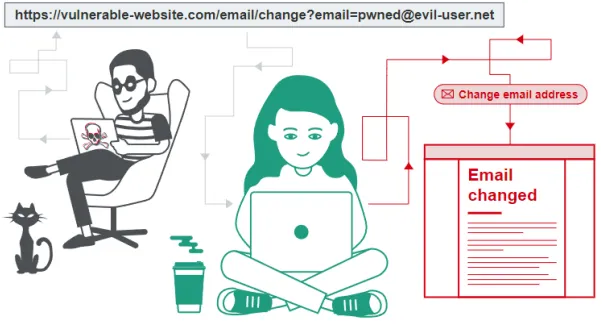
Impact of the attacks are;
EXAMPLE OF CSRF ATTACK
Let’s considers this vulnerable application that allows users to change their password via a POST request. The original form looks like this:

The attacker can create a copy of this form, changing the password to one known by the
attacker (123 in this example):

Unlike the original form, the attacker’s version does not have a submit button, and has a script that automatically submits the form as soon as the user loads the HTML.
PREVENTATION
The most common way to prevent CSRF attack is to include a CSRF token within relevant requests. The token must meet the following criteria:
Also CSRF token should be created randomly using timestamp and transfer it to user in a hidden way